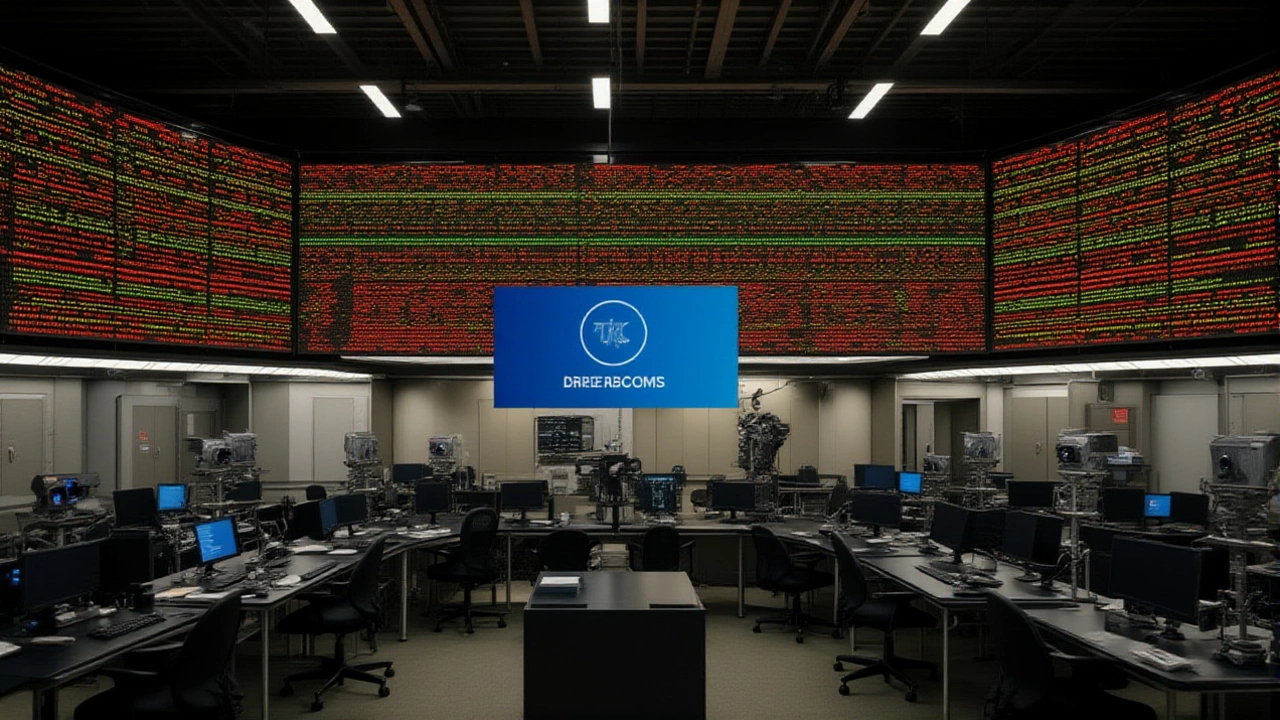
When the Chicago Mercantile Exchange lost power to its critical data center cooling systems early Friday morning, the ripple effect wasn’t just technical—it was financial. By 7:30 a.m. CT on November 28, 2025, traders across the globe noticed delays, timeouts, and outright halts in pricing feeds for everything from S&P 500 futures to crude oil contracts. The outage, triggered by a cascading failure in redundant chillers at a facility just outside the Chicago metropolitan area, shut down access to CME Globex for over five hours. While trading resumed before the regular session opened, the damage was done: CME Group Inc. (ticker: CME) shares slid nearly 1.0% in premarket trading, a rare but telling signal that investors now see infrastructure fragility as a material risk.
What Went Wrong—and Why It Mattered
The cooling system failure didn’t come out of nowhere. According to Bloomberg Television’s market update at 0:02:10 UTC, engineers scrambled to restart multiple chillers and deploy portable cooling units to stabilize temperatures inside the primary data center. This wasn’t a power outage. It wasn’t a cyberattack. It was a mechanical one: a failure in the thermal regulation system that keeps thousands of server racks from overheating during peak trading hours. The facility, located in a high-density tech corridor near O’Hare, handles roughly 21 million contracts daily—about $1 quadrillion in notional value annually. When the chillers failed, the servers throttled down to prevent damage. Trading froze. The timing couldn’t have been worse. November 2025 has been one of the most volatile months for global equities in recent memory. Central bank signals, inflation data, and geopolitical tensions had already jittered markets. This outage didn’t cause the volatility—it amplified it. Traders couldn’t hedge positions. Market makers couldn’t price risk. Even institutions with backup feeds experienced latency spikes. "It just wasn’t the news that the markets needed," noted Bloomberg’s on-air analyst 'A.C.'A Second Strike in Six Years
This was the second major disruption at the Chicago Mercantile Exchange since 2019. Back then, a software glitch in the clearing system halted U.S. Treasury futures trading for nearly three hours. That incident led to internal audits and minor upgrades. But this time, the failure was physical—and it exposed a deeper vulnerability: reliance on aging infrastructure in a climate where heat waves are becoming more frequent. The facility, built in the early 2010s, was never designed for the sustained 24/7 loads it now carries. The CME Group Inc. reported $6.33 billion in revenue for 2024, yet its capital allocation for infrastructure resilience remains opaque to the public.Market Reactions and Regulatory Shadows
Investors reacted quickly. The 1% drop in CME stock might seem small, but for a company with a $120 billion market cap, that’s over $1.2 billion in erased value in minutes. Analysts at J.P. Morgan noted that the decline was disproportionate to the actual trading volume lost—suggesting the market was punishing CME for perceived operational risk, not just downtime. "This isn’t about lost trades," said one institutional trader who spoke anonymously. "It’s about whether you can trust the backbone of global derivatives pricing. If the chillers fail, what else might?" The U.S. Commodity Futures Trading Commission (CFTC) and the Securities and Exchange Commission (SEC) are expected to request a detailed incident report within 10 business days. While CME Group has not issued a public statement, internal documents show that the company’s business continuity plan includes failover to a secondary data center in Aurora, Illinois—but that site was already operating at 92% capacity during the outage. No failover was triggered because the issue wasn’t network-related—it was thermal.What’s Next for Global Financial Infrastructure?
The outage has reignited debates about the concentration of financial infrastructure in a few geographic hubs. While European and U.K. bond markets remained unaffected—trading on entirely separate platforms—this event underscores how deeply interconnected global markets are through U.S.-based clearinghouses. The Chicago Mercantile Exchange isn’t just a U.S. exchange; it’s the price discovery engine for commodities, interest rates, and currencies worldwide. Industry experts are now calling for mandatory resilience benchmarks for critical financial infrastructure. "We regulate banks for capital ratios. We regulate airlines for safety checks. Why not require data centers serving financial markets to meet minimum cooling redundancy standards?" asked Dr. Elena Ruiz, a fintech infrastructure scholar at the University of Chicago. "This wasn’t an act of God. It was an act of neglect."Behind the Scenes: The Engineering Response
CME’s engineering teams worked through the night, bypassing failed chillers and deploying industrial-grade portable cooling units—similar to those used in military field operations. By 3:15 p.m. CT, core trading functions were restored. But the recovery wasn’t seamless. Some clients reported lingering latency in order execution. Others saw discrepancies in settlement prices between CME Globex and competing platforms. These aren’t just technical glitches—they’re legal and compliance risks.Frequently Asked Questions
How does this affect retail investors?
Retail investors using platforms like Robinhood or E*TRADE to trade futures or ETFs tied to CME contracts may have experienced delayed pricing, slippage, or failed orders during the outage. While no direct losses were reported, the incident exposed how dependent everyday traders are on infrastructure they can’t see or control. The CME’s failure to communicate clearly during the outage also eroded trust among smaller participants.
Why didn’t backup systems kick in automatically?
The backup data center in Aurora, Illinois, is designed for network or power failures—not thermal events. Since the primary site’s servers were still powered and online, just overheating, the failover protocol didn’t activate. This reveals a critical flaw in the design: redundancy is only as good as the scenario it’s built for. Engineers now say the system needs to monitor temperature thresholds as a trigger condition, not just connectivity.
What’s the financial impact of this outage?
No official loss figures have been released, but market analysts estimate $200–400 million in lost trading volume during the five-hour window. More significantly, the 1% drop in CME Group’s stock wiped out over $1.2 billion in market value. The real cost may lie in long-term reputational damage—especially if regulators demand costly upgrades or impose fines for inadequate risk controls.
Is this outage related to climate change?
While the immediate cause was mechanical, the broader context isn’t. Chicago experienced its hottest November on record in 2024, with average highs 5.7°F above normal. Data centers generate immense heat; cooling them requires more energy—and becomes riskier in hotter climates. Experts warn that without climate-resilient design, similar failures could become seasonal events, not anomalies.
Could this happen again?
Absolutely—if no changes are made. CME Group has not disclosed whether it’s upgrading its cooling infrastructure or adding new redundancy layers. With over 15,000 server racks operating in that facility, and no public audit of its thermal systems, the risk remains high. Traders are already asking: "Will the next failure happen in winter—or during the next heat dome?"
How does this compare to other financial outages?
The 2019 Treasury futures outage was shorter and software-related. In 2021, the London Stock Exchange had a 7-hour outage due to a firmware bug. But this is the first major failure of its kind tied to physical infrastructure in the U.S. derivatives market. Unlike cyberattacks, which are intentional, this was a preventable mechanical breakdown—making it more concerning to regulators and institutional clients alike.